Olivia’s Move to Pittsburgh

Moving Olivia into her New Apartment in Pittsburgh

It’s been more of an ordeal than we expected to get Olivia set up in Pittsburgh. The application process for her new apartment (in the Squirrel Hill neighborhood of the city) was exhaustive and exhausting, but Olivia finally got keys to the place over her lunch break (from her new design job with Weisshouse in the Shadyside neighborhood of the city). And then Marci and I drove the minivan full of her stuff around 4:30 PM so we could all get her moved in at the end of the work day.

Moving Olivia into her New Apartment in Pittsburgh

The last leg of the transition went pretty smoothly. But Olivia and I had our own Don-Quixote-and-Sancho-Panza-vomiting-in-each-other’s-faces sort of moment yesterday, as we were loading items from her storage unit and into our vehicles. At one point, Olivia was having trouble closing the tailgate of her insight because of a dresser-top mirror, so I leaned in from the rear corner of the car to adjust the piece’s position (fearful that she might break the piece and/or the rear window of her car by trying to close the tailgate more forcefully) — but she didn’t notice my (admittedly unannounced) intervention, and she slammed the tailgate down on my head! I saw stars for a moment and staggered away to regain equilibrium. Olivia felt really bad, and she apologized — and I forgave her immediately — but I got a goose-egg bump, bruise, and scrape on my upper-right forehead to show for it all.

Moving Olivia into her New Apartment in Pittsburgh

So we are quite literally — and figuratively — banged up from this transition. But it feels pretty good to have gotten to such a key moment in the process.

Moving Olivia into her New Apartment in Pittsburgh

Olivia had a lot of emotions at this defining moment in her young life: happiness, sadness, gratitude, anxiety, excitement, fear… Lots of tears, lots of hugs. The whole experience was pretty different from when we moved Elliot to Pittsburgh 25 months ago. The weather was not as hot or humid. The move was not as complicated, with just a smaller amount of stuff to be carried a shorter distance with fewer stairs or tight corners. But it’s still a pretty big deal to deal with a new job, a new home, and a new city all within the space of a couple of weeks! I’m glad that we all got through it together, and that Olivia and Elliot get to be in the same city that’s still within driving distance of where we live.

Moving Olivia into her New Apartment in Pittsburgh

Olivia’s new neighborhood seems lovely. There’s a notable Jewish influence in Squirrel Hill, with girls in uniforms from the Yeshiva School, men with long beards and yarmulkes, a Jewish bookstore, and such. But there are lots of people from lots of different backgrounds in the neighborhood, too. I think and pray and hope and expect that Olivia will be able to build a life for herself in Squirrel Hill and in Pittsburgh more generally.

Moving Olivia into her New Apartment in Pittsburgh

After we were finished with all the moving, we walked a little less than half a mile to a Japanese restaurant called Mayasushi. It was good food with casual conversation, and it felt like we all got to take some deep breaths after a sustained stretch of stress and sucking for air. When we finished dinner and walked back to Olivia’s apartment, Marci read a liturgy from Every Moment Holy while we sipped some celebratory sparkling wine and prayed for our daughter in this new phase of her life.

Moving Olivia into her New Apartment in Pittsburgh

Marci and I are still learning a lot about how to be good parents for young adults. It’s harder than we thought. Still, it’s an honor to witness and provide strategic support (when requested) for a lovely young woman like Olivia.

Posted in Family, God, Middle Age, Prayer, The United States of America, Transition, Travel, Weather, Young Adulthood | Leave a comment

A Little Worter Dranking Party

Grace's Little Worter Dranking Party

It’s been a week since the death of Wendell Berry, and I’m still processing the loss. I’ve found it helpful to do some of my own writing about the writer who mentored me in the finer points of human mortality. I’ve read through some of my favorite passages from some of my favorite books, and I’ve also picked up a book of Berry’s poetry (though it’s less familiar to me than his prose). It’s also been helpful to talk about the legacy of Wendell Berry with friends.

Grace's Little Worter Dranking Party

Over the weekend, my friend Grace hosted “a little worter dranking party.” She invited one of our mutual friends who was most familiar with Berry’s essays… another mutual friend who hadn’t read any of Berry’s writing but was intrigued by second-hand stories… one of her college friends who studied English literature and developed a special affinity for Berry’s poetry… her landlord, who loved Berry’s essays and poems, and who is a something of a poet himself… and me, with my pronounced fondness for Berry’s novels and short stories.

When we arrived, a small card table held snacks like cheddar popcorn, no-bake cookies, and sugared pecans, as well as drinks like maple bourbon smash and old-fashioned cocktails (mixed with real Kentucky bourbon). A fire had been kindled in the fire pit.

After finding seats around the fire, Grace read a passage from Jayber Crow that described a fictional gathering not unlike our eclectic circle, except we were invited by text messages whereas the fictional guests were invited by handwritten notes, saying:

Come to a little worter dranking party Sat night at the Grandstand. Whatever you want to delute your worter with will be fine.

This fictional invitation to a fictional place in the fictional town of Port William, Kentucky, came from the hand of a fictional character named Burley Coulter. But here’s where fiction manages to hold more truth than real life: condensing mundane details and expanding internal emotions and experiences of intimate community. Throughout Wendell Berry’s books, Burley Coulter is the best example of a flawed-but-favorite character from Port William. He wasn’t educated, but he was intelligent (I feel compelled to note that his misspellings on that invitation to the “little worter dranking party” were at least partially intentional, perpetuating an inside joke). He disappeared from society regularly, but he always seemed to be there when it mattered most. He fathered a child out of wedlock, but he demonstrated greater faithfulness to his family than most fathers. He was a loner, but he fostered community: off-the-grid, late at night, by personal invitation.

Grace's Little Worter Dranking Party

I believe that when Wendell Berry wrote about Burley Coulter and Jayber Crow and all the rest, he was writing about himself. About all of us, really. Before biking over to Grace’s place, I had marked a passage in my copy of Jayber Crow, which called back to the jug passed around at that little worter dranking party, and which I read aloud by firelight:

I am a man who has hoped, in time, that his life, when poured out at the end, would say, “Good-good-good-good-good!” like a gallon jug of the prime local spirit. I am a man of losses, regrets, and griefs. I am an old man full of love. I am a man of faith.

I’m thankful for the legacy of Wendell Berry. I’m thankful for friends with whom I can share the losses, regrets, griefs, love, and faith. Amen.

Posted in Uncategorized | Leave a comment

Pawpaw Patrol

Foraging for Pawpaws on the Campus of Kent State University

I didn’t learn about pawpaws until I was in my forties. They are native to eastern North America, including the entire state of Ohio, and they lay claim to the title of “largest edible fruit indigenous to the United States.” But I’ve never seen them sold in supermarkets. I think I learned about pawpaws from watching videos on the internet, so I started looking for them a few years back: in the forests… at farmer’s markets… and through my own network of friends who had also started wondering about pawpaws… All to no avail, until this weekend!

Foraging for Pawpaws on the Campus of Kent State University

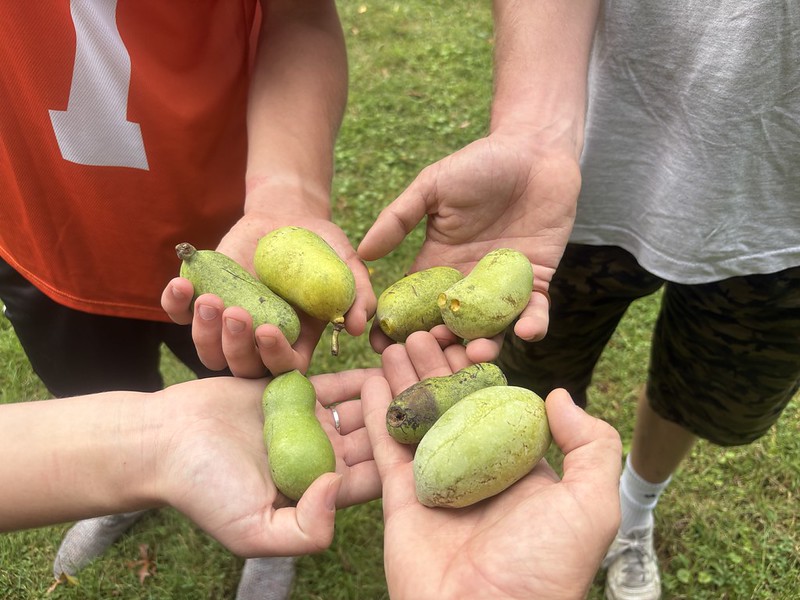
My friend Lauren shared a map and some pictures that helped to identify a potential site for foraging pawpaws right on the campus of Kent State University! So I followed her directions, and it turned out there’s actually a whole grove of pawpaw trees between the Science Mall and the residential section of campus. Several large pawpaws were still growing on the branches, along with leaves that resembled oversized hickory leaves, and there were also several ripe pawpaws that had just recently fallen to the ground.

Foraging for Pawpaws on the Campus of Kent State University

With four of us from our family fanning out around the area, we managed to find several pawpaws. Some had been nibbled by other critters, so we left those where they lay. But several others were in perfect condition for human consumption, at varying levels of ripeness.

Foraging for Pawpaws on the Campus of Kent State University

It seems like the best way to eat pawpaw is to slice the fruit in half with a knife (like a mango) and then use a spoon to scoop out the flesh of the fruit (like a kiwi) and then spit out the seeds (like a watermelon).

Pawpaw Presentation

The pawpaws’ taste and texture evoke banana… avocado… mango… pineapple… Surprisingly tropical for something grown in our area. Our whole family agreed that it’s quite good, though I noticed that nobody was particularly eager for seconds. Still, it’s free food! It feels like a bit of a treasure hunt, foraging for these fruit, so I hope to keep observing the passage of the seasons and pleasures of this local produce for years to come.

Pawpaw Presentation

If you want to find some for yourself, here are some GPS coordinates for one of the trees we found: 41.14612, -81.34006.

Posted in Family, Food, Home, Kent, Ohio, Photography, Recreation | Leave a comment

MARIGOLD

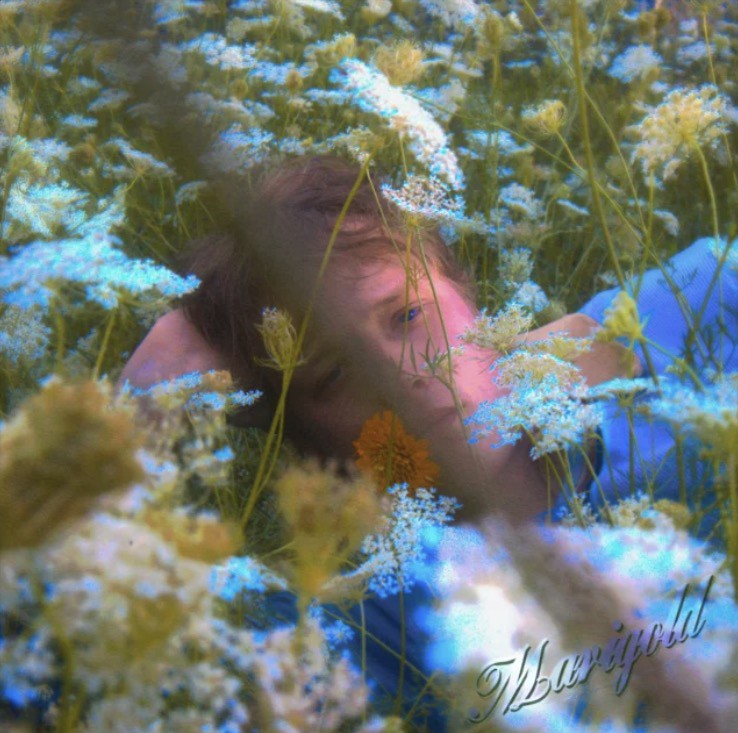
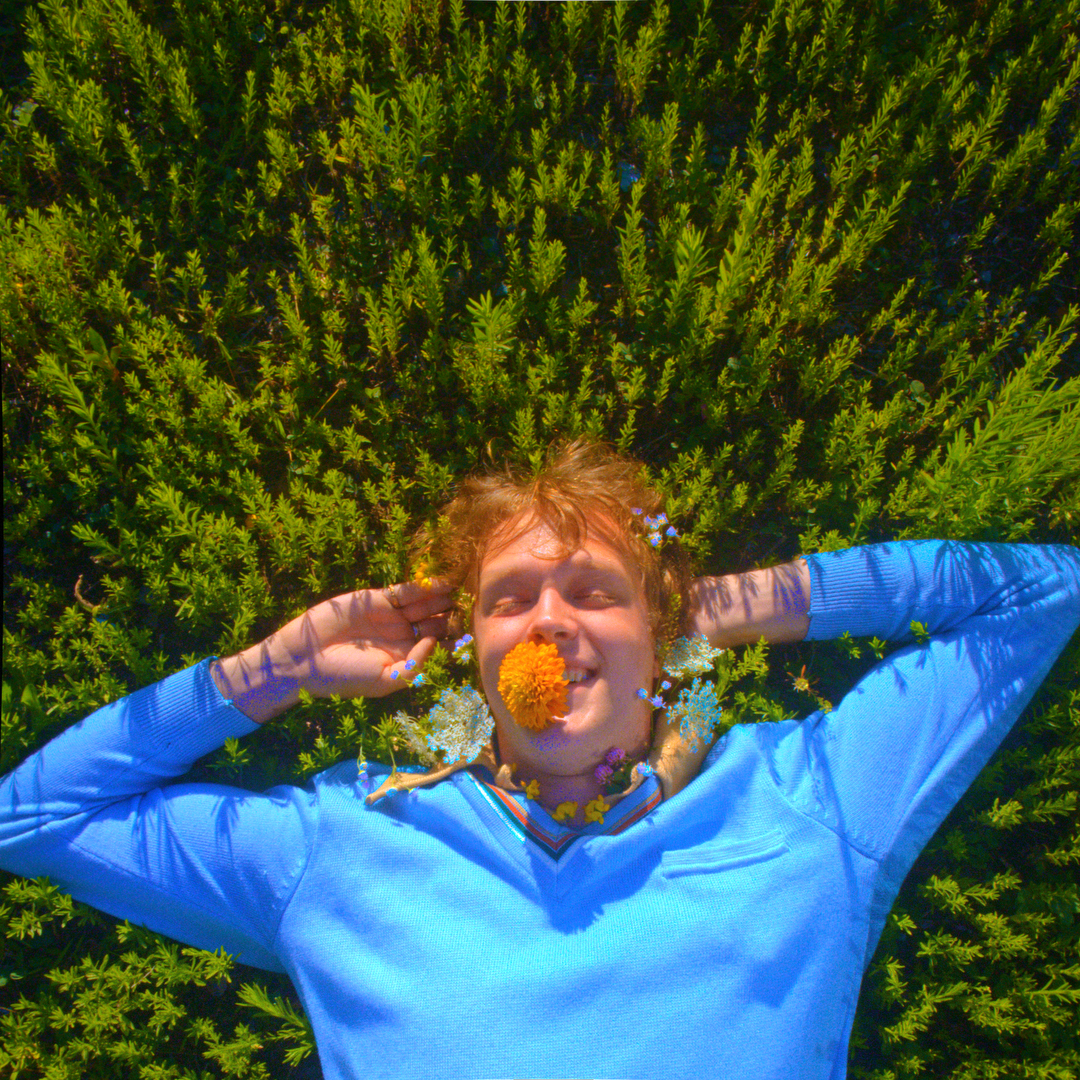
My son Elliot has been writing songs for decades. Seriously. Like, basically since he’s been literate. I won’t embarrass him by sharing anything from deep in the archives. I’m just saying: he’s been working on this stuff for a while. And now he’s put something out on music streaming services and social media — in collaboration with another Pittsburgh artist — and that is something to celebrate!

His first single, “MARIGOLD,” is a bop. And I’m not just saying that because it’s my son’s (and my son’s friend’s) song. The song makes me want to dance and sticks in my head. I find myself humming it and singing it hours after listening to it. If you want to find this new release for your own listening pleasure, the artist name (specific to this collaborative project) is MANIAM, and their main presence in the public sphere right now is the MANIAM Instagram account. A music video for this single can also be found on Instagram Reels. They even got a write-up from a local music magazine, which reveals a fun twist to the lyrics:

In a more condensed form, I can just tell you that the magazine write-up describes MARIGOLD as a “love song for the sun.”

Let’s take you back to March 2026. The sun is finally poking through after a long, cold winter, and Michal and Elliot are reminded of how much they’ve missed her… Help us show MANIAM the love they show the sun in this glowing debut single, “MARIGOLD.” And don’t forget the third member of the group, Michal’s cat and artist manager Basil, featured in every song Michal has released to date.

Let me know if you give it a listen — and what you think of it, if you do. I’m proud of Elliot for a lot of different reasons, but this is certainly one of them.

Posted in Family, Music, Recommendations, Recommended Listening, Recreation, Weather, Young Adulthood | Leave a comment

Sula

I recently finished reading the novel, Sula, by Toni Morrison. It was recommended to me by my daughter Olivia, and she is one of those people whose reading recommendations I take especially seriously. I had read a couple of Morrison’s other books, decades ago, but Sula was one of Morrison’s earlier, lesser-known works. Olivia told me about the book at the end of the spring or the beginning of the summer, but it didn’t become available from my local library until early-August. Fortunately, I was able to read the whole thing in a single borrowing cycle once I got it. And I was really glad for the reminder of what a masterful writer Toni Morrison really was.

Sula, by Toni Morrison

The story centers around a fictional town called Medallion, Ohio: specifically around a Black community called The Bottom. In the wake of the First World War, the people of The Bottom are struggling with poverty, family dysfunction, mental illness, and grief. The narrative eventually centers around two young girls, best friends named Sula and Nel, who are coming of age in the 1920s, and they provide a fascinating window into this period of a person’s life as well as this period of history.

Before Sula takes center stage in the narrative, however, her grandmother Eva carries the plot. And in a lot of ways, Eva ended up being my favorite character in the book. Maybe because I’m in a phase of life where I relate to her struggles, but maybe because she’s just a really well-wrought character. Eva is a single mother who forges her way through the hardships of life on just one leg. Literally. There’s some insinuation that she may have caused the amputation of her own leg in order to claim an insurance settlement from the railroad company. But with the leg that remains, Eva proves herself a force to be reckoned with. She wears fine stockings and shoes to adorn that one leg that remains, and she buys a large house in The Bottom for her family. She raises her son and her daughters in unconventional ways, and she even becomes a sort of foster-parent to other lonely people in the community. She’s a sympathetic character…

But she’s not exactly saintly. She gives the same name to three of her foster-children, who become sort of blended together (despite their differing ages and complexions) to be known simply as “the deweys.” And Eva seems to maintain a strange sort of emotional distance, almost dismissiveness, in her relation to the deweys — as well as her relationship to her biological descendants. She demonstrates a particularly sad and complicated relationship with her son Plum, who comes back from the Great War struggling with mental illness and a drug addiction. She clearly maintains affection for him, but she also becomes the means by which he meets a violent end to his life. In addition to that, Eva establishes a legacy of sexual liberality that complicates the lives of her daughters and her granddaughter, Sula. She assumes the position of a proud, powerful matriarch — which is noble, considering her circumstances — but this ultimately leads to her own downfall when Sula steps into the position of power within the family and confines Eva to a nursing home.

Sula herself is a very complicated character. She’s even more complicated than Eva, to the point of feeling like something of a “bad guy.” She grows up with a passive relationship to the trauma unfolding around her and seemingly shrugs off her powerlessness to do anything about it. She watches a neighborhood boy drown in the river and cannot say anything to the only adult who could potentially do anything about it. She watches her mother’s dress catch fire and burn her so badly that she dies. When she becomes a young adult, she leaves The Bottom and doesn’t communicate with her family or friends for over a decade. When she comes back to The Bottom, she provides no explanation to Eva or Nel. She remains aloof and apparently uncaring about anyone or anything.

She starts casually sleeping around with some of the men in Medallion, and before long she seduces Nel’s husband — leading to a severing of one of the few relationships that meant much of anything in her life. It’s sad and confusing for everyone, including the reader. And honestly, Sula’s life remains difficult all the way up to terminal illness and death. The biggest point of redemption in the book is when Nel chooses to visit Sula on her death bed. There’s not exactly any resolution, reconciliation, or restoration between the old friends, but there is some sense of sympathy restored. Sula dies on her terms, and Nel finds a way forward on hers.

It’s not a happy story. And it’s not a particularly long story, either. But I think these characteristics of the story mirror the human experience, writ large. Thus there is value, and even beauty, in a story like this. It shows the injustices that span generations and make our individual stories less consequential, really, in the grander scheme of things. It shows the way that we are marred by misfortune and pain as we grow up. And it shows that forgiveness may be one of the most powerful paths through the pain, even if it’s not easy. Because none of it is easy. But we’re all in it together.

In any event, the writing is beautiful. The settings and characters are complex and multi-dimensional — even in such a short book, which speaks to Morrison’s skill as an author. The content is compelling, even if it’s also saddening. I wouldn’t say this is Morrison’s best book, as I remember Beloved being an absolute masterpiece — even though I’ve forgotten much of the actual content of that book from when I read it in college. But I’m very glad I got the chance to experience Sula for myself.

Posted in Adolescence, Aging Parents, Family, Home, Middle Age, Old Age, Reading, Recommendations, Recommended Reading, Recreation | Leave a comment

Relevance, Respect, and Reverence

A Visit to Port William

I’m still limping through this stretch of the calendar. We’ve brought our painting project to a good stopping point. Welcome Week has mostly run its course. We got Cor moved back into BGSU. Olivia is starting a new job in Pittsburgh this week. Our house has been restored to a sense of normalcy that allows Marci and me to feel all right about hosting people again. There are reasons to believe that we’re right on the cusp of regaining rhythm and settling into a groove. And maybe life will feel better after some further repetition and rest (and getting past Olivia’s move into a new apartment in Pittsburgh)…

But I’m noticing that sadness has been catching up with me whenever I slow down. I’m starting to wonder if I’m grappling with my mortality in new ways these days. I’m continuing to practice the quiet life to which I feel that God has called me. I’m putting in the work as a faithful farmer, mindful of my forty acres. And it really does seem reasonable to expect that I will maintain this trajectory for the rest of my life, until the day I die. I’m not so worried about the prospect of my death, honestly, but I think I’m starting to come to terms with the decades of diminishing, or dwindling, relevance, respect, and reverence from others. It feels like I’ve started that long, slow slide — with my sons and daughter becoming increasingly independent and with new organizational structuring in H2O Kent changing my roles to help push younger leaders forward.

I know I’m not completely irrelevant. But I am intentionally trying to detach myself the world’s systems for power, fame, and wealth, and I’m realizing that this is causing me to lose step with others who prioritize such pursuits. I’ve been thinking of Dolly Parton and Wendell Berry — both of whom have died within the last week — and while they are rightly revered upon death, the fact of the matter is that their best work was really put out 30 or 40 years ago, and they weren’t considered particularly relevant to last week’s news cycles. Only their deaths have brought a spike in reverence and retrospectives. I wouldn’t have wished for an earlier death for either artist, and I wouldn’t have wanted them to stop writing or living out their core messages to whatever extent they were still able to do so. But the truth of the matter is that I just didn’t like “Rockstar” (2024) as much as “Islands in the Stream” (1982) or “Jolene” (1974), and I didn’t like Marce Catlett (2025) as much as Jayber Crow (2000) or The Wild Birds (1985). That’s just how life seems to go.

The respect piece is tied to the relevance (or lack thereof). I’ve noticed a couple of times in the last couple of weeks when students from our church have seemed to be rolling their eyes at me — like when I asked an icebreaker question about painting an object (such as Marci and me painting our house), or trying to parse the semantics of using emoticons vs. emoji… None of these were particularly meaningful things — but they felt like a foretaste of what the coming decades might hold for me. We all become increasingly decrepit if we live long enough. And it’s just harder for younger people to summon real respect for another adult they perceive to be less capable. I’m still a long way away from anyone thinking about giving me the ol’ Eskimo Elder Eviction: cut loose on an ice floe to drift out to sea and die. But the respect is already starting to erode, and there will at least be some who will be increasingly inclined to think of me as a “silly old man.” And that’s hard.

The reverence is the last thing to go — and we’re culturally conditioned to conjure it back up at the time of a person’s death. As relevance and respect fade, there may be some consolation in the way that I might be increasingly embraced as “Dear Old Dad” and “Grandpa” and “Church Elder” and “Elder Statesman” and “_____ Emeritus.” But even that seems likely to fade towards the end. Dolly Parton did more than most to keep herself in that place of reverence through her philanthropy and public appearances and dying sooner than most of us were expecting. But Wendell Berry… and Queen Elizabeth II… and other great artists and diplomats typically withdraw from the public sphere because of increasing disability and (maybe subconsciously) a desire to control their public image with the help of their family. This allows them to keep a more functional version of themselves at the front of mind for the general public. Even so, I’m guessing that it’s plenty hard and humbling to realize that the reverence that might remain for some is contingent upon their ignorance of how things really are in a given moment. “If only they knew…” must be a terrifying thought to live with until (1) everyone comes to know, and/or (2) I no longer have the capability to know. Either way, it’s hard to maintain reverence through that last, steep decline before death.

At death, everything changes. Reverence is restored first. Maybe eventually a measure of respect and even a sort of retrospective relevance. But these are ultimately short-lived, too. It only takes a generation or two until we’re just names in a cemetery, a genealogy, an archive. At least, that’s the case for most of us. Almost certainly for me. That feels sad, emotionally, but it probably shouldn’t, intellectually. It’s the logical conclusion of the processes I’ve been considering for a while now: the grass withering… the flower fading… the shadow passing… I really do think that I can find contentment in the quietude and the seasonal rhythms of “farm” life. I just need to make peace with the face from relevance, respect, and reverence.

Posted in Church, God, Grief, H2O Kent, Health, Introspection, Leadership, Middle Age, Old Age, Transition | Leave a comment

Man of La Mancha

I read the 1605 book which was originally and officially titled The Ingenious Gentleman Don Quixote of La Mancha. And as I mentioned in my book report blog post, it definitely felt like a 400-year-old work of literature. I suggested that most people in the 21st Century might be better served by just watching the 1972 film adaptation of the 1965 musical theater production Man of La Mancha, rather than reading the book. But then it occurred to me that it might be fun to follow my own advice and revisit the 20th Century productions of the story. So I did, and now I’m honestly not so sure about things…

I listened to the Broadway Original Cast Album from the 1965 stage production, shortly after finishing the book itself. And this might actually be my favorite rendering of the story. I’d seen the film version of this show previously, so I had enough background to understand how the stories and songs fit together. I just don’t know how much the story would make sense if this would be the only version employed.

Honestly, this album moved me to tears. The singing is beautiful (far better than the film version), and the voice acting is also top-notch. The progression of the songs tell the story of Don Quixote pretty effectively, but the music alone omits some key context. In particular, it’s harder to understand from the album how the Man of La Mancha story is a blend of Don Quixote plus the real-life author of the book, Miguel de Cervantes, plus the love story and other plot conventions expected of 20th Century musical theater. It’s really good, though, and I would honestly be curious to hear if anyone might be so bold as to take my advice and start with the Broadway Original Cast Album from the 1965 stage production.

I watched the 1972 film this weekend. And it’s main advantage is that it’s a smaller time commitment than reading the book (at 2 hours and 12 minutes of playing time). But after this most recent viewing, I confess that it really feels like a 54-year-old movie. The story moves slowly. The actors talk funny, with their speech almost bordering on Mid-Atlantic accents. Sophia Lauren feels shoe-horned into her role as Aldonza / Dulcinea — clearly added to the cast for her star power and sex appeal more than her acting or singing. Peter O’Toole’s performance as Alonso Quijano / Don Quixote is pretty good, but still very much of another era.

Let me just say this: I went into my viewing highly-motivated to see it and appreciate new things about the story, but I came out of it kind of bored and disillusioned. The action of the story wasn’t enough to keep me fully engaged (i.e. off my phone) throughout the viewing. And there were some moments when I actively cringed at the film’s rendering of the story. It’s not as magical as I hoped it would be. It’s still probably the best, most complete rendering of the story for those who would wish to get the main ideas from Don Quixote without the labor of reading through 1,000 pages of antiquated language and stylistic sensibilities of a different era. But man! I wish someone would do a revival of the stage production and/or the film for 21st Century audiences…

All that being said, I was actually impressed with how much the action of Man of La Mancha stayed true to the original story in Don Quixote. There are even some subtle nods to plotlines from the book that got cut yet still serve as Easter eggs for those who know (i.e. one of the prisoners calling himself the Duke… some off-handed references to Sancho’s wife and donkey, which got much longer treatment in the book… the gentleman’s books being burned near the end of the movie, etc.). Man of La Mancha includes almost all of the best scenes from Don Quixote, except for the scene that was perhaps my favorite, in Chapter 18 of the first volume of the book.

In Chapter 18, we get way more context for the phrase that the play and film render as “Knight of the Woeful Countenance.” And it’s really quite a funny scene, too. Don Quixote and Sancho Panza see dust clouds in the distance, and they sally forth to assess the situation and “give aid and assistance to the weak and those who need it.” Sancho sees the cause of the dust clouds as the book’s readers are led to see it: with two flocks of sheep approaching one another, guided by shepherds. Don Quixote, however, sees the cause of the dust clouds as two great armies approaching each other. The knight-errant tells his squire stories about the gleaming armor and the noble standards carried by the great warriors of the opposing armies, and then he charges into the fray himself — killing seven sheep and causing the shepherds to use their slingshots to pelt Don Quixote with rocks until he is battered, bruised, and disabled. Most of his teeth are missing after this encounter. His face is in a sorry, or woeful, or rueful, state.

Don Quixote drinks a potion that he believes to be a magical cure, though it is actually an emetic, and he asks Sancho to come and help him assess the damages — which leads to a scene that actually had me rolling with laughter:

Sancho came so close that he almost put his eyes into his mouth; now just at that moment the balsam had acted on the stomach of Don Quixote, so, at the very instant when Sancho came to examine his mouth, he discharged all its contents with more force than a musket, and full into the beard of the compassionate squire… [At which point Sancho involuntarily returns the favor, repulsed to the point] that his stomach turned, and he vomited up his inside over his very master, and both were left in a precious state.

It’s really a pretty amazing scene. And honestly, the phrase “Knight of the Woeful Countenance” doesn’t make all that much sense without it, since Sancho starts introducing his master by this title after Chapter 18. So, if someone does end up doing a revival of Don Quixote and/or Man of La Mancha, I hope they will bring this scene back into the story. All in all, the story of Don Quixote has been a boon to my summer — in all of its various forms. It’s gotten me through some monotonous hours of household chores. It’s gotten me thinking about aging and idealism. And it’s gotten me to wondering about the ways that this story could be useful for future generations, too. And if that’s not the mark of a good story, I don’t know what is.

Posted in Introspection, Middle Age, Old Age, Recommendations, Recommended Listening, Recommended Viewing, Recreation, Video | Leave a comment

A Theology of the Ordinary

I recently finished reading the book, A Theology of the Ordinary, by Julie Canlis. It was recommended to me by my friend John, after many conversations about life and ministry and humility and faith. I’ve been telling him about my increasing conviction of the priority of faithfully farming my forty acres… and acknowledging my smallness and respecting God’s greatness… and making it my ambition to live a quiet life… And John said, in effect, “Well, have I got a book for you!” And then he literally mailed me his own personal copy of A Theology of the Ordinary, including his marginalia. It felt like such an intimate, pastoral gesture that I started reading it immediately, as a part of my morning Coffee Time with God. And within a week, I was finished.

A Theology of the Ordinary, by Julie Canlis

One of the things that stood out to me was Canlis’s reading of the Bible and of American culture. Like me, she grew up in the United States but then lived in Europe for years (seventeen, in her case) before moving back. And there’s just something about that transition between cultures that illuminates the proverbial “air we breathe” or “water in which we swim.” So this book is a careful meditation on biblical truths that counter “this cultural obsession with greatness and being ‘impactful’ (a new word that had cropped up in American usage while we were away) and how it was infiltrating the church.”

The author traces the rise of American Evangelicalism, starting with Charles Finney in the late-1700s and following the line down through the big tent revivals of the early-1900s. And then, in a dramatic twist, the American Evangelical Exceptionalism is juxtaposed with the slow, organic work of God creating the Garden of Eden, as recorded in the first chapters of the Bible. Canlis gives an astute analysis of the Creation story, and then she summarizes some of the implications in a plain, practical, yet also artistic, way: “All of life is spiritual. Work. Bearing children. Hobbies. Friendship. Repairing gutters. Commuting. This is our worship — the offering of our everyday stuff to God. As Romans 12:1 says, ‘Take your everyday, ordinary life… and place it before God as an offering.'”

This section of the book reminded me a lot of the ways that God has recently impressed upon me the value of good, honest work.

Through each section of the book — organized about the unique implications of the Trinity upon an “ordinary life,” with historical heresies that function as corresponding counter-stories — the writing is theologically-rich, with abundant biblical references and end notes for each section (my only real semi-scholarly question was about the author’s interpretation of the Greek verb from the second chapter of the Gospel of Luke, which is translated into our English Bibles as some variation on Jesus “growing in wisdom and stature” but could maybe be translated as him “beating his way forward by blows,” which she apparently drew from T.F. Torrance). But what I appreciate even more than the theology is the way of writing it in an ordinary way, which supports the central thrust of the book very well. She writes with a sense of humor, but not stretching for zingers. She just grounds her writing in good, strong, everyday language — like the insertion of “repairing gutters” into the list of things that can be spiritual, as quoted above. The book feels more meditative than academic. And it gets us out of our heads and into the real world, too. This section from the last chapter of the book is an excellent example:

If we are going to talk about the new creation which is already underway, we have to talk about (brace yourselves) the church. The new creation has begun in Christ but the focal location for this miracle is the little backwards church and irregular people down the street. Talk about ordinary! All too often, we speak of being “in Christ” or of “my relationship with Christ” without recognizing what this means. When we are put into Christ, we are united with other people and with creation. Being in Christ is not primarily a mystical location, as we have been told; it is first and foremost a geographical one! Most of us would prefer to be united with Christ, but not to His brothers and sisters or to the ordinary location that He has appointed for all this to happen. When the Spirit joins us to Christ, he head of the church, we are brought into a living, dynamic reality that is greater than the sum of its parts.

I’m really glad I got to read this small book that makes a big statement about the way we might envision ourselves to live, both individually and communally. I’d highly recommend it for anyone who wonders about finding one’s place in this world, or who feels tension with the American Evangelical exceptionalism that has shaped generations, or who just wants to walk with God in simple, everyday rhythms.

Posted in Church, Family, God, Health, Introspection, Leadership, Ministry, Reading, Recommendations, Recommended Reading, Small Groups, The Bible, The United States of America | Leave a comment

Kicked Off

H2O Kickoff on the Student Green

We’ve done it! We’ve kicked off a new year of ministry with H2O Church at Kent State University! Tonight was the culmination of ten days of outreach, with an outdoor preview of our Worship Gatherings and Life Groups. And it went really well.

H2O Kickoff on the Student Green

Between you and me, though, it wasn’t as easy as we made it look.

H2O Kickoff on the Student Green

Over the summer, we learned about some pretty significant changes to the University’s room reservation processes, which required us to think creatively about some of the ways we do ministry. In the midst of multiple meetings, emails, and phone calls, we missed the 30-day window for reserving our preferred space for our H2O Kickoff event on the Thursday of the first week of classes. And that’s largely on me, as the one from our Staff team who oversees University relations and room reservations. I honestly lost some sleep over this misstep.

Risman Plaza Chalk, with Mistake

In the end, we decided that our best option was to reserve some outdoor space in the center part of campus. The Student Green is actually a lovely spot, right in the middle of campus, where foot traffic is consistently heavy at just about any hour of the day. But this location also depends on favorable weather. And at the beginning of this week, the weather forecast for a 40 percent chance of rain on Thursday evening. Fortunately, the chance of rain kept dropping with each day that we approached the Kickoff. And we felt pretty confident that the outdoor location was going to work, as we got within the last 24 hours leading up to the event.

Then there was a malfunction with the University’s sprinkler system. One University employee told us that the sprinklers watering the grass are supposed to shut off at 7:30 AM. And maybe they did. But the sprinklers were back to (or possibly had never stopped) soaking the Student Green at 11:00 AM. We didn’t think too much of it, since it would be getting full sun all afternoon, but when we came to set up around 3:30 PM, the sprinklers were still running. When maintenance was finally able to turn off the water around 4:00 PM, there were two inches of standing water on some parts of the Student Green. Just four hours before the official start time of our event. The middle part of the Student Green wasn’t too squishy or muddy, though, so we decided to press on with our plans for the H2O Kickoff.

H2O Kickoff on the Student Green

The outdoor location certainly had its stresses, but on the plus side — it was easy for Kent State University students to find us. That’s really the goal of this event: helping students to know that there is a church on campus, a space for spiritual development among one’s peers. In addition to providing opportunities to see how we worship and how we teach from the Bible, we introduced our church’s Life Groups and sent out coolers of frozen treats to the four corners of campus where students could meet and mingle with other students (and staff and volunteers) from the different groups. There were about forty of us who walked from the Student Green to Crawford Hall in the North part of campus, and it really was lovely to get some space to interact with new people.

H2O Kickoff on the Student Green

For most of the walk across campus, I talked with a young woman from Cincinnati named Havana — and I got to learn how she has started following Jesus over the last couple of years. I enjoyed some brief interactions with Foster and James, and I got connected on LinkedIn with a young first-year student named Ryan. I ate a chocolate-covered ice cream bar while talking with Madison and Grace, and then I ate a frozen fruit bar while talking with two women named Kearston, whose first, middle, and last names were remarkably similar even though they had just met each other that night. Marci and I got to talk together with Najmul and Miri, who are from Bangladesh. And I also got to develop some good rapport with Patricia and Milka, from Rwanda, when I applied a lesson that some other Rwandan students had just taught me about the pronunciation of their country’s name (two syllables, not three). It really was a pretty great night, honestly.

I’m glad that we got things kicked off. And I’m also looking forward to seeing how things start to run on their more typical course from this point forward. Thanks to all of you who have been praying with us and for us!

Posted in Church, God, H2O Kent, Kent, Ministry, Prayer, Small Groups, The Bible, Weather, Young Adulthood | Leave a comment

Welcome Week 2026

H2O at KSU Blastoff

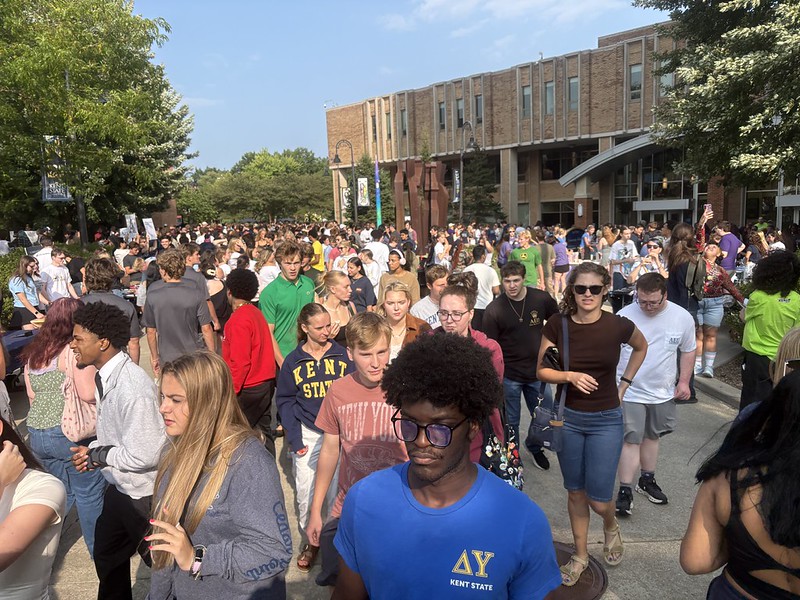
Last night, H2O‘s Welcome Week events reached its apex with the annual Kent State University Blastoff. The University’s Center for Student Involvement decided to make this year’s edition of Blastoff fit within a smaller geographic area, a smaller block of time, and with a smaller number of upperclassmen representing the various student organizations — which brought us a lower quantity of interactions with new students… but perhaps also a higher quality of interactions with new students.

H2O at KSU Blastoff

Some years, the Blastoff stretches quite a ways up and down the Esplanade (the large central sidewalk through campus), and even out towards Manchester Field and the Centennial Fields. But this year, all of the tables for the various student organizations were squeezed onto Risman Plaza and the Student Green. The event was also capped at two hours in length (from 5PM to 7PM), with no fireworks or laser light show or dance party at the end (as they’ve sometimes had in years past). And student organizations were instructed to stay behind their tables with a maximum of four people per table. So we certainly tried to make the most of the opportunities we were given at our place in the Blastoff, proper.

H2O at KSU Blastoff

At the same time, we also consulted with the University and decided to set up a “Blastoff Recovery Zone,” out on the fringes of the actual Blastoff event. At first we set up near Henderson Hall, not knowing what the geographic footprint of the actual Blastoff would be, but we eventually moved to a more highly-trafficked area near Manchester Field. And this seemed to be a restful supplement to the sensory overload encountered by students at the official event. We had coolers full of cold drinks, and snacks, and blankets, and games with H2O students standing by to connect with newcomers.

H2O at KSU Blastoff

While helping to staff the Blastoff Recovery Zone, I got into conversation with a non-binary student from Columbus named Mac, who is just starting Year One of studying Architecture at Kent State. Our interaction stayed relatively superficial, but pleasant. An H2O sophomore from Columbus named Isabelle joined our conversation, and she talked about some of the ways that God met her over the course of the summer — so Mac got a real glimpse of spiritual things during our short interaction. But it’s hard to know what sort of impact that moment may have had, as Mac walked away shortly afterwards.

H2O at KSU Blastoff

I also talked with Sage for a while yesterday evening. It’s her second year at Kent State University, but she felt like she didn’t make as many friends as she would have liked during her first year — so she wanted to make a conscious effort to try getting involved with student organizations on campus. I told her that H2O’s Life Groups could be a good space to find community, and I introduced her to an H2O senior named Aiden, since he helps to lead the Life Group for students from Sage’s part of campus. She eventually decided to fill out one of our interest surveys, so she could receive more information about the Life Group.

Operation Blue & Gold: Day One

Throughout the last week, I’ve met so many different people who have remained in my thoughts and prayers: Pradesh, a PhD candidate from Nepal, studying Computer Science… Armand, who serves a mean volleyball… Axel, who played volleyball despite hobbling around on an injured Ankle… Malika and Beyoncé, from Rwanda (pronounced as two-syllables, not three, as I had previously understood), who were sincerely excited to hear about a church on campus… Natsumi, from Japan, who was on her third day in the United States and already looking for a place where she could get some good Japanese Food… Jaden, a vlogger studying Public Relations… Chloe, from the Kent State University Marching Band’s Color Guard… Erik, who had a rough summer back home in Maryland…

Welcome Week Hour of Prayer

I really believe that our most strategic work may be prayer: both during Welcome Week and after Welcome Week. There will still be plenty of opportunities to put down more chalk on the University’s sidewalks… and invite students to fill out interest surveys… and make connections at our H2O Kickoff on Thursday night… But God is ultimately responsible for causing spiritual germination and growth, so I’m going to keep praying and keep an eye out for what happens.

As a case in point, we finished the night with about 500 Interest Surveys completed. That’s only half of the number of Interest Surveys that were completed at this point last year, most likely because of shifts in the University’s approach to Blastoff. But — there were still about 400 people who expressed actual interest in H2O follow-up communication regarding our Bible studies, worship gatherings, and/or questions about Christianity, compared to about 500 people expressing actual interest last year. So, we shifted from a 50 percent interest rate to an 80 percent interest rate. Which is intriguing. Again, we just have to keep praying and keep an eye out for what happens. But things are up and running, in any event!

Posted in Church, God, H2O Kent, Kent, Ministry, Photography, Prayer, Transition, Young Adulthood | Leave a comment