

When I was ten years old, I wanted to be the President of the United States: historically-significant, powerful, internationally-famous. When I was twenty years old, I wanted to be a Filmmaker: artistically-significant, famous, creative, intelligent, insightful. When I was thirty years old, I wanted to be an influential Church Leader: spiritually-significant, world-changing, ground-breaking, respected within a particular religious demographic. When I was forty years old, I thought I was supposed to strive towards broader influence as a network leader through things like speaking at conferences, serving on boards, and offering sage counsel as a Consultant: more deeply influential among influential people, beloved, revered, sought after, frequently cited by others.
But now that I’m approaching the age of fifty, I’m sincerely wondering if I should just climb down the “corporate ladder” (as short and non-profit as it may be). I’m wondering if my job for the coming decades is to boost younger leaders on their climb up, leaving me to cultivate the earth and get dirt under my fingernails with the work of evangelism and discipleship, sowing and reaping, faithfully farming my forty acres until retirement or death. 1 Thessalonians 4:11 has been stuck in my craw: “Make it your goal to live a quiet life” (NLT). “Aspire to live quietly” (ESV). “Make it your ambition to lead a quiet life” (NIV). I thought about memorizing, or maybe even getting a tattoo of the Greek — φιλοτιμεῖσθαι ἡσυχάζειν, or “philotimaisthai haisuchazain“— but it’s a mouthful. But I wondered if it still might be the kind of thing Augustus MacRae would fashion into a motto for the sign to go along with the business of shepherding souls instead of selling cattle and stabling horses. And that made me wonder what the verse might be in Latin, since that would have been Gus’s preferred nod to the classical languages, anyway). And it sounded even better than I expected:
et operam detis ut quieti sitis
The Latin got me thinking about a coat of arms. Like what Don Quixote would have emblazoned on a flag to be unfurled as he rode into battle (though, in my case, it would be more likely to appear on a T-shirt or a sticker). A bit of a tongue-in-cheek exercise, but still a fun way to memorize the phrase and repeat it to myself. Maybe even occasionally to others. A “rallying cry” that is actually the opposite of a rallying cry. To cultivate a true thirst for quiet and hang my hat on this peaceful presence. I thought up some imagery that might lend itself to such purposes, like: a mouse… a mole… a sailboat on a quiet sea… an oak tree… a dandelion with its seeds blowing away… stained glass windows… the Cuyahoga River… a fern… a yellow trout lily… a trillium… a shepherd’s staff… And then I sketched out an illustration of a mouse riding on top of a mole, through a field of dandelions that feel like trees, with the mouse carrying a cane like a knight carries a lance, with a wildflower for a plume.
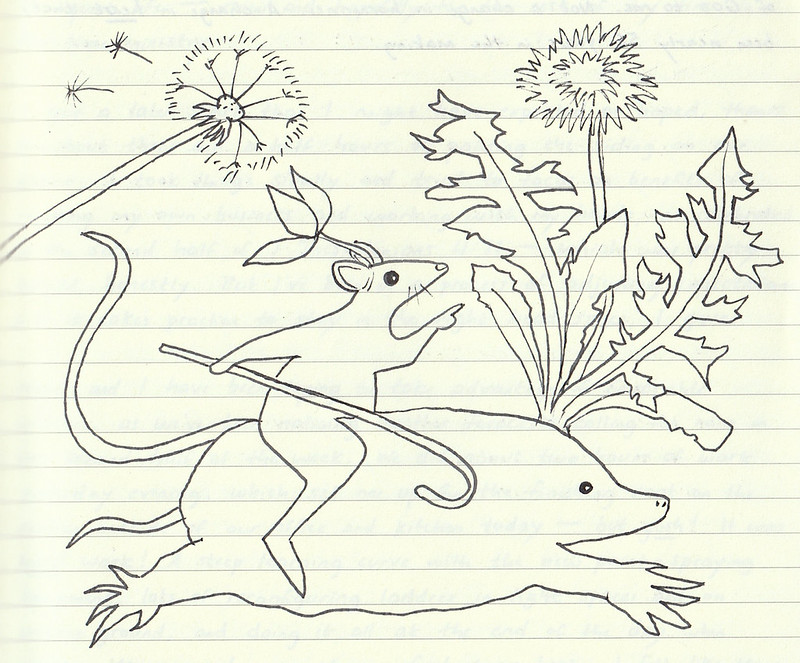
I liked leaning into the quixotic (idealistic, impractical, and romantic) nature of this aspiration for diminution. After a while, I looked up how to make a real, personalized, old-fashioned coat of arms, and I decided to give it a crack.

It didn’t turn out great. Especially with the spacing and flourishes and graphic design. But I learned that I really liked the mole in the place where most coats of arms put a royal lion, or an eagle, or a stag, or whatever. I liked its subversion of the expectations for such a device. I also thought it looked kind of funny and cool in profile, and I decided that it’s a more appropriate symbol than a mouse because it’s more underground, more of a working-class digger. Evocative of a farmer and his forty acres of soil, perhaps. Just a very humble animal, but kind of endearingly so. I also decided that the shepherd’s staff was more important than I’d previously thought. It’s also agrarian, agricultural, and farm-core — which I appreciate — while also being a symbol that the Church has used for a long time as a representation of pastoral care and modelling ourselves after the Great Shepherd.

My first draft of my coat of arms had two dandelions: one blooming, and one blowing away. But I wondered if it might be valuable to swap out one dandelion for a fern leaf, or oak leaf, or aspen leaf, or something else? I initially tried to copy the helmet and the flowing cloths, but then I started to wonder if I should replace the helmet with a ball cap and the flowing cloths with some of the mandala shapes and fill-shading that I often use in journaling.

The second draft of the coat of arms (shown above) made some of these adjustments, albeit imperfectly. And I ultimately decided to add a Bible with the Greek text for John 1:1 as a charge on the dexter of the shield — representing the Word of the Lord that stands forever, in contrast to the wildflower that fades so quickly. And it definitely felt like a step forward, but I felt I could do better with the design, spacing, and using some organic forms of flourishes on the mantle, instead of the cloths or abstract shapes.
My latest iteration (shown at the top of this post) adds in all those ideas, plus a river and some color. And I really like the way it’s turned out. I will probably leave this coat of arms project at that. But I’m open to any suggestions that more experienced designers might have — and/or to reworking it further myself, whenever I might feel like it.