

I didn’t learn about pawpaws until I was in my forties. They are native to eastern North America, including the entire state of Ohio, and they lay claim to the title of “largest edible fruit indigenous to the United States.” But I’ve never seen them sold in supermarkets. I think I learned about pawpaws from watching videos on the internet, so I started looking for them a few years back: in the forests… at farmer’s markets… and through my own network of friends who had also started wondering about pawpaws… All to no avail, until this weekend!

My friend Lauren shared a map and some pictures that helped to identify a potential site for foraging pawpaws right on the campus of Kent State University! So I followed her directions, and it turned out there’s actually a whole grove of pawpaw trees between the Science Mall and the residential section of campus. Several large pawpaws were still growing on the branches, along with leaves that resembled oversized hickory leaves, and there were also several ripe pawpaws that had just recently fallen to the ground.

With four of us from our family fanning out around the area, we managed to find several pawpaws. Some had been nibbled by other critters, so we left those where they lay. But several others were in perfect condition for human consumption, at varying levels of ripeness.
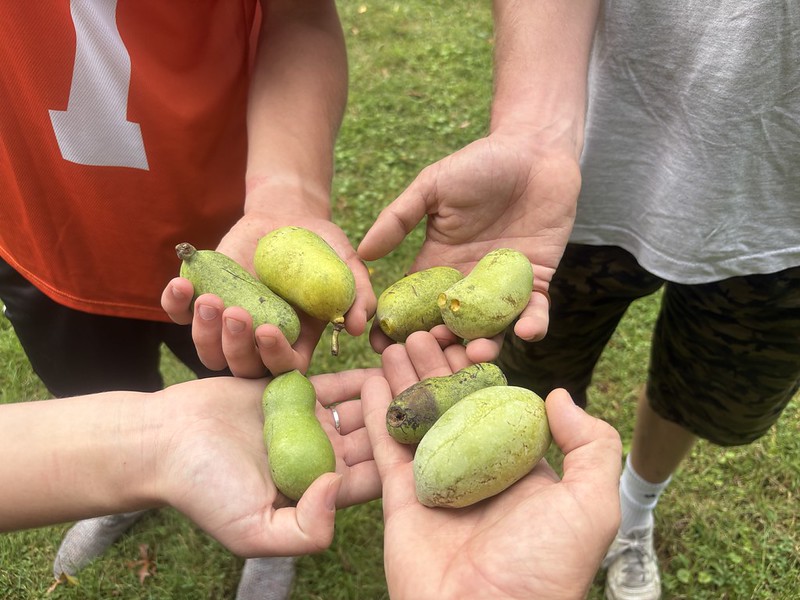
It seems like the best way to eat pawpaw is to slice the fruit in half with a knife (like a mango) and then use a spoon to scoop out the flesh of the fruit (like a kiwi) and then spit out the seeds (like a watermelon).

The pawpaws’ taste and texture evoke banana… avocado… mango… pineapple… Surprisingly tropical for something grown in our area. Our whole family agreed that it’s quite good, though I noticed that nobody was particularly eager for seconds. Still, it’s free food! It feels like a bit of a treasure hunt, foraging for these fruit, so I hope to keep observing the passage of the seasons and pleasures of this local produce for years to come.

If you want to find some for yourself, here are some GPS coordinates for one of the trees we found: 41.14612, -81.34006.