
I read the 1605 book which was originally and officially titled The Ingenious Gentleman Don Quixote of La Mancha. And as I mentioned in my book report blog post, it definitely felt like a 400-year-old work of literature. I suggested that most people in the 21st Century might be better served by just watching the 1972 film adaptation of the 1965 musical theater production Man of La Mancha, rather than reading the book. But then it occurred to me that it might be fun to follow my own advice and revisit the 20th Century productions of the story. So I did, and now I’m honestly not so sure about things…
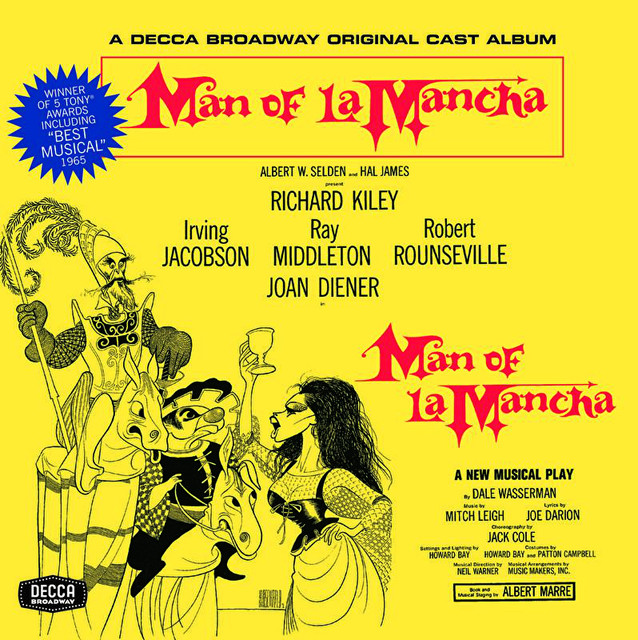
I listened to the Broadway Original Cast Album from the 1965 stage production, shortly after finishing the book itself. And this might actually be my favorite rendering of the story. I’d seen the film version of this show previously, so I had enough background to understand how the stories and songs fit together. I just don’t know how much the story would make sense if this would be the only version employed.
Honestly, this album moved me to tears. The singing is beautiful (far better than the film version), and the voice acting is also top-notch. The progression of the songs tell the story of Don Quixote pretty effectively, but the music alone omits some key context. In particular, it’s harder to understand from the album how the Man of La Mancha story is a blend of Don Quixote plus the real-life author of the book, Miguel de Cervantes, plus the love story and other plot conventions expected of 20th Century musical theater. It’s really good, though, and I would honestly be curious to hear if anyone might be so bold as to take my advice and start with the Broadway Original Cast Album from the 1965 stage production.
I watched the 1972 film this weekend. And it’s main advantage is that it’s a smaller time commitment than reading the book (at 2 hours and 12 minutes of playing time). But after this most recent viewing, I confess that it really feels like a 54-year-old movie. The story moves slowly. The actors talk funny, with their speech almost bordering on Mid-Atlantic accents. Sophia Lauren feels shoe-horned into her role as Aldonza / Dulcinea — clearly added to the cast for her star power and sex appeal more than her acting or singing. Peter O’Toole’s performance as Alonso Quijano / Don Quixote is pretty good, but still very much of another era.

Let me just say this: I went into my viewing highly-motivated to see it and appreciate new things about the story, but I came out of it kind of bored and disillusioned. The action of the story wasn’t enough to keep me fully engaged (i.e. off my phone) throughout the viewing. And there were some moments when I actively cringed at the film’s rendering of the story. It’s not as magical as I hoped it would be. It’s still probably the best, most complete rendering of the story for those who would wish to get the main ideas from Don Quixote without the labor of reading through 1,000 pages of antiquated language and stylistic sensibilities of a different era. But man! I wish someone would do a revival of the stage production and/or the film for 21st Century audiences…
All that being said, I was actually impressed with how much the action of Man of La Mancha stayed true to the original story in Don Quixote. There are even some subtle nods to plotlines from the book that got cut yet still serve as Easter eggs for those who know (i.e. one of the prisoners calling himself the Duke… some off-handed references to Sancho’s wife and donkey, which got much longer treatment in the book… the gentleman’s books being burned near the end of the movie, etc.). Man of La Mancha includes almost all of the best scenes from Don Quixote, except for the scene that was perhaps my favorite, in Chapter 18 of the first volume of the book.
In Chapter 18, we get way more context for the phrase that the play and film render as “Knight of the Woeful Countenance.” And it’s really quite a funny scene, too. Don Quixote and Sancho Panza see dust clouds in the distance, and they sally forth to assess the situation and “give aid and assistance to the weak and those who need it.” Sancho sees the cause of the dust clouds as the book’s readers are led to see it: with two flocks of sheep approaching one another, guided by shepherds. Don Quixote, however, sees the cause of the dust clouds as two great armies approaching each other. The knight-errant tells his squire stories about the gleaming armor and the noble standards carried by the great warriors of the opposing armies, and then he charges into the fray himself — killing seven sheep and causing the shepherds to use their slingshots to pelt Don Quixote with rocks until he is battered, bruised, and disabled. Most of his teeth are missing after this encounter. His face is in a sorry, or woeful, or rueful, state.
Don Quixote drinks a potion that he believes to be a magical cure, though it is actually an emetic, and he asks Sancho to come and help him assess the damages — which leads to a scene that actually had me rolling with laughter:
Sancho came so close that he almost put his eyes into his mouth; now just at that moment the balsam had acted on the stomach of Don Quixote, so, at the very instant when Sancho came to examine his mouth, he discharged all its contents with more force than a musket, and full into the beard of the compassionate squire… [At which point Sancho involuntarily returns the favor, repulsed to the point] that his stomach turned, and he vomited up his inside over his very master, and both were left in a precious state.
It’s really a pretty amazing scene. And honestly, the phrase “Knight of the Woeful Countenance” doesn’t make all that much sense without it, since Sancho starts introducing his master by this title after Chapter 18. So, if someone does end up doing a revival of Don Quixote and/or Man of La Mancha, I hope they will bring this scene back into the story. All in all, the story of Don Quixote has been a boon to my summer — in all of its various forms. It’s gotten me through some monotonous hours of household chores. It’s gotten me thinking about aging and idealism. And it’s gotten me to wondering about the ways that this story could be useful for future generations, too. And if that’s not the mark of a good story, I don’t know what is.