My friend Daniel is hosting a series called Weird U.S. — and the first episode just dropped! I’m a big fan of Daniel, not just as a personality but as a person. He’s a man of quick wit and high character. So, I wanted to hype up his new project.
The show describes itself as follows:
Weird U.S. is the digital revival of a multi-million-copy cult favorite book franchise, reimagined as a YouTube travel channel for discovering America’s most peculiar places, hidden histories, offbeat traditions, and unforgettable characters.
We celebrate the wonderfully weird side of America, one state at a time.
I recently came across a Sean McKeever video on TikTok (his bio reveals that he also has a regular website). And I thought it was so clear and helpful that I thought I should share it. Particularly since it involves an area of concern for many young adults, like the ones who happen to be a part of my family and who happen to be a part of the church I lead.
In this video, McKeever notes that, “A University of Kansas study found that it takes approximately 50 hours to move from acquaintance to casual friend. It takes 90 to become a good friend. And then it takes 200+ hours to be a close, or best, friend. Importantly, the quality of the time matters a lot.” He then sketches out a chart on a piece of paper that calls to mind “back-of-the-napkin” figuring, and I thought it did a great job of demystifying the process of building friendships.
Casual Friend
Hours to make: 50 hours
Years at 3 hours per month: 1.4 years
Years at 3 hours per week: 0.3 years (3.5 months)
Good Friend
Hours to make: 90 hours
Years at 3 hours per month: 2.5 years
Years at 3 hours per week: 0.6 years (7 months)
Close / Best Friend
Hours to make: 200 hours
Years at 3 hours per month: 5.6 years
Years at 3 hours per week: 1.3 years
At the end of the video, he suggests, “If you want community, build a routine around it. Ideally with people nearby: same people, same time, every week, if you can help it. Make the hours easy to repeat, start stacking them up, profit.”
I’ve often told the young adults I know that it just takes time, that there’s no way that a friendship of three months can compare to a friendship of three years (much less three decades). So I encourage them to manage their expectations, practice patience, and gradually accrue the relational capital that will allow you to replicate the relationships that have meant the most to them in previous phases of life and locations in which they’ve lived. I choose to believe that there is still some mystery involved, but I also appreciate how practical and mathematical this can be as evidenced by the McKeever video and the University of Kansas study upon which it was based.
When I was ten years old, I wanted to be the President of the United States: historically-significant, powerful, internationally-famous. When I was twenty years old, I wanted to be a Filmmaker: artistically-significant, famous, creative, intelligent, insightful. When I was thirty years old, I wanted to be an influential Church Leader: spiritually-significant, world-changing, ground-breaking, respected within a particular religious demographic. When I was forty years old, I thought I was supposed to strive towards broader influence as a network leader through things like speaking at conferences, serving on boards, and offering sage counsel as a Consultant: more deeply influential among influential people, beloved, revered, sought after, frequently cited by others.
But now that I’m approaching the age of fifty, I’m sincerely wondering if I should just climb down the “corporate ladder” (as short and non-profit as it may be). I’m wondering if my job for the coming decades is to boost younger leaders on their climb up, leaving me to cultivate the earth and get dirt under my fingernails with the work of evangelism and discipleship, sowing and reaping, faithfully farming my forty acres until retirement or death. 1 Thessalonians 4:11 has been stuck in my craw: “Make it your goal to live a quiet life” (NLT). “Aspire to live quietly” (ESV). “Make it your ambition to lead a quiet life” (NIV). I thought about memorizing, or maybe even getting a tattoo of the Greek — φιλοτιμεῖσθαι ἡσυχάζειν, or “philotimaisthai haisuchazain“— but it’s a mouthful. But I wondered if it still might be the kind of thing Augustus MacRae would fashion into a motto for the sign to go along with the business of shepherding souls instead of selling cattle and stabling horses. And that made me wonder what the verse might be in Latin, since that would have been Gus’s preferred nod to the classical languages, anyway). And it sounded even better than I expected:
et operam detis ut quieti sitis
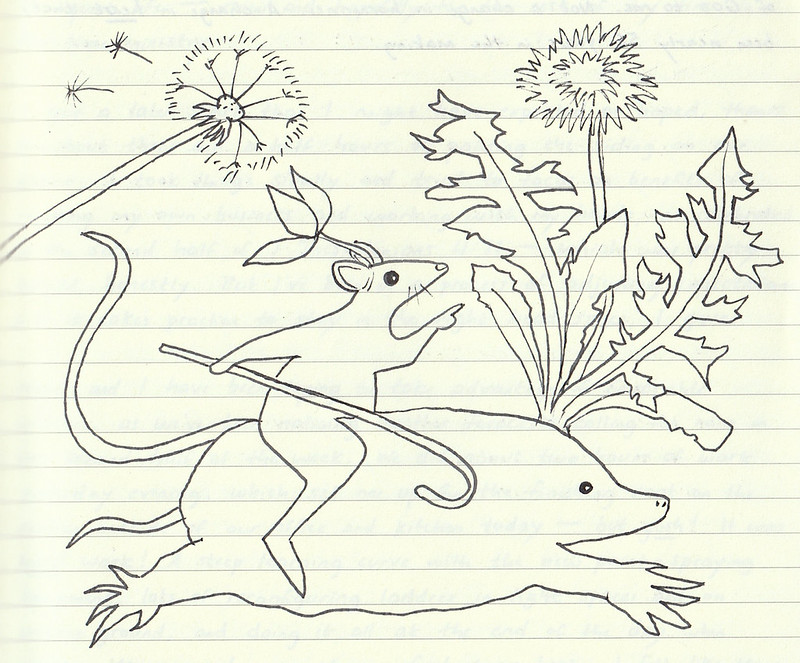
The Latin got me thinking about a coat of arms. Like what Don Quixote would have emblazoned on a flag to be unfurled as he rode into battle (though, in my case, it would be more likely to appear on a T-shirt or a sticker). A bit of a tongue-in-cheek exercise, but still a fun way to memorize the phrase and repeat it to myself. Maybe even occasionally to others. A “rallying cry” that is actually the opposite of a rallying cry. To cultivate a true thirst for quiet and hang my hat on this peaceful presence. I thought up some imagery that might lend itself to such purposes, like: a mouse… a mole… a sailboat on a quiet sea… an oak tree… a dandelion with its seeds blowing away… stained glass windows… the Cuyahoga River… a fern… a yellow trout lily… a trillium… a shepherd’s staff… And then I sketched out an illustration of a mouse riding on top of a mole, through a field of dandelions that feel like trees, with the mouse carrying a cane like a knight carries a lance, with a wildflower for a plume.
It didn’t turn out great. Especially with the spacing and flourishes and graphic design. But I learned that I really liked the mole in the place where most coats of arms put a royal lion, or an eagle, or a stag, or whatever. I liked its subversion of the expectations for such a device. I also thought it looked kind of funny and cool in profile, and I decided that it’s a more appropriate symbol than a mouse because it’s more underground, more of a working-class digger. Evocative of a farmer and his forty acres of soil, perhaps. Just a very humble animal, but kind of endearingly so. I also decided that the shepherd’s staff was more important than I’d previously thought. It’s also agrarian, agricultural, and farm-core — which I appreciate — while also being a symbol that the Church has used for a long time as a representation of pastoral care and modelling ourselves after the Great Shepherd.
My first draft of my coat of arms had two dandelions: one blooming, and one blowing away. But I wondered if it might be valuable to swap out one dandelion for a fern leaf, or oak leaf, or aspen leaf, or something else? I initially tried to copy the helmet and the flowing cloths, but then I started to wonder if I should replace the helmet with a ball cap and the flowing cloths with some of the mandala shapes and fill-shading that I often use in journaling.
The second draft of the coat of arms (shown above) made some of these adjustments, albeit imperfectly. And I ultimately decided to add a Bible with the Greek text for John 1:1 as a charge on the dexter of the shield — representing the Word of the Lord that stands forever, in contrast to the wildflower that fades so quickly. And it definitely felt like a step forward, but I felt I could do better with the design, spacing, and using some organic forms of flourishes on the mantle, instead of the cloths or abstract shapes.
My latest iteration (shown at the top of this post) adds in all those ideas, plus a river and some color. And I really like the way it’s turned out. I will probably leave this coat of arms project at that. But I’m open to any suggestions that more experienced designers might have — and/or to reworking it further myself, whenever I might feel like it.
Anyone who belongs to Christ has become a new person. The old life is gone; a new life has begun! (2 Corinthians 5:17)
Greetings from Kent! We made it through Fall Retreat and almost to Kent State University’s Fall Break (a four-day weekend coming up October 8-11)! I can’t say we made it totally “unscathed,” as Marci and I have been dealing with some sickness for a few weeks now. But that’s not uncommon at this time of the year: maybe a little bit like a farmer who’s worked hard to get seed in the ground under favorable conditions, dirty and depleted and dragging myself into the daily chores for a while afterwards. Even so, October in Ohio feels life-giving. And we’re hopeful for the work that God is doing in Northeast Ohio these days.
To give you a little glimpse of that work, I thought I would share the testimony of a Kent State senior named Emmett. He shared this at the Fall Retreat before his baptism, and I found it so encouraging that I asked him if he could send me (and, by extension, you) a copy:
My journey to becoming a Christian has truly been a life-long journey. I didn’t grow up in a Christian household, but for one reason or another I was always interested in the human life, consciousness, and what happens when we die. This natural curiosity led me to always being open about whether there was a God or not.
I remember growing up and always knowing about church and kids who went but just figured that was something they did, and we as a family didn’t. When I was 16 years old, I used an app called iFunny quite frequently. It wasn’t what I would call a good or a wholesome app. Anyone from anywhere could say and post just about anything, and they did. But for one reason or another, the app became filled with Christian posts, advertising Christianity and Jesus. This actually got me to think deeply for the first time in my life if there was an afterlife or not, and if there was, where would I end up?
I discussed these things with my friend group who were all Christian, and they kept pointing to Jesus. I wanted to believe Jesus was my savior, but my biggest problem in accepting Christ as my savior was me trying to have faith that he actually was the son of God, both fully man and God, performed miracles, and died on the cross for our sins.
This passive openness to Christ came to a breaking point after I had graduated high school. I had no direction, had a falling out with my best friend, my dad was struggling with alcohol addiction, and I was working third shift in a hot warehouse, not wanting to live anymore. One of these shifts I had enough. I cried out to God in the back of a hot semi truck trailer at 11:30 pm and asked him if he was real or not. I felt this strong presence of him, I was overcome with emotion, and I felt him tell me that I need to seek him and join a church when I go to Kent State. This didn’t make any sense to me, join a church at a college?
But I listened. I got to Kent State, and within the first week of school went on my laptop, looked for a church group, found H2O, and emailed a man named Eric Asp. Eric met with me for coffee, and for almost 3 hours he answered the most theologically difficult questions I had about Christianity and religion, the best he could. I came away from that conversation realizing that if this man can defend Christianity for 3 hours, then it might just be the way.
I was invited to Life Group, and attended for a few months. I then started attending the church services. I found peace within the group but still wasn’t fully ready to accept Christ. Then came the H2O Network Conference. All of the H2O churches from across the country were in one big conference hall praising the Lord. Seeing a thousand people sing worship songs and subsequent sermons that were given convinced me that Christ really is King and he is my savior. In January of 2023 I gave my life to Christ. I now wish to be baptized as showing to everyone I am born again and the old me is dead.
Isn’t that an amazing story?!? And you are a part of it, thanks to your financial support and prayer support! Thank you for making stories like Emmett’s possible. As you may know, we’ve been chipping away at a deficit in our funding. And praise God: Another $150/month in new support has come in since last month! We’ve still got a little more than $700/month left to raise, though. Please keep praying for God’s provision in this. We’ll be in touch…
Jana Life-Ozanich photographs H2O Fall Retreats better than anyone else I’ve ever seen. Even the static stuff, like the large-group portrait that we try to capture every year: it just looks better through the lens of Jana’s photography.
I know from my own experience (and also from times that other professional photographers have filled in) that it’s hard to be in the right place at the right time. It’s hard to get the exposure right (especially with so many different lighting conditions throughout the course of an event like the Fall Retreat). It’s hard to release the shutter at just the right moment. But Jana makes it seem effortless.
The best photographers figure out a way to capture personalities and emotions: both in candid shots and in posed portraits. And it seems to me that it’s not just a technical skill. It’s a social savviness. Maybe even a spiritual gift.
I thought I’d share ten of my favorite photographs from Jana’s collection, featuring a variety of different moments from last weekend’s Fall Retreat.
I think I am finally turning the corner from a week of fighting off a sinus infection that followed two weeks of fighting off a virus, all of which was likely compounded by the poor diet and sleep patterns at Fall Retreat. A weekend like that is not without its cost.
But after a week of rest and recovery, I am also seeing that a weekend like that is also not without its benefits.
Now that we’re all back in Kent, we’re settling into our regular rhythms for the school year, and I’m thankful for that.
I’m particularly excited to keep coaching the student-leaders and “shepherding the flock” from North Campus, going forward.
We’re settling into the “North Campus” label almost a year after our shift from the residence halls to academic spaces, and it’s kind of fun to have “North Campus” T-shirts and a silly moose motif and our own group portraits now, to solidify our distinct community identity.
I’m noticing an uptick in my empathy for others. I think there are numerous catalysts for this, but I sincerely believe that one of them is Mister Rogers. I recently rewatched the film, “A Beautiful Day in the Neighborhood,” and it was striking to see the way that Mister (Fred) Rogers influenced people from all different walks of life through his empathy.
He actively coached his viewers in how to recognize and manage their feelings on the television program itself. But even more than the on-air persona, I keep thinking about the way that the film depicts Mister Rogers interacting with people who were often disregarded by others. Jesus might have called such people the “least of these.” Mister Rogers would carefully observe and listen, and then he would regularly ask the “least of these” to pray for him. If others asked why he did this, he replied that he sincerely desired their intercession. He saw that a child who has lived with cerebral palsy or a man on his death bed must be very close to God — so who wouldn’t covet their prayers?!? He didn’t ask for prayer as a way to manipulate them or prop up their egos or make them feel seen. He just saw them and valued them and interacted with them as real humans. He prayed for them, too. But that empathy and appreciation for others is what made Mister Rogers truly special.
The film (starring Tom Hanks) was based on the 1998 Esquire article, “Can You Say… Hero?,” written by Tom Junod. It’s a really good article. Certainly more worth your time than this blog post. The piece captures the essence of Mister Rogers in some really creative ways, including unique and irreverent anecdotes from the journalist’s personal experiences interacting with Mister Rogers as well as adopting Mister Rogers’s tone in explaining key concepts throughout the article. Here’s an example from a scene when Mister Rogers visits New York City:
Then the car stopped on Thirty-fourth Street, in front of the escalators leading down to the station, and when the doors opened — “Holy shit! It’s Mister Fucking Rogers!” — he turned into Mister Fucking Rogers. This was not a bad thing, however, because he was in New York, and in New York it’s not an insult to be called Mister Fucking Anything. In fact, it’s an honorific. An honorific is what people call you when they respect you, and the moment Mister Rogers got out of the car, people wouldn’t stay the fuck away from him, they respected him so much.
There’s another excellent film, a documentary, called “Won’t You Be My Neighbor?” And this film corroborates the idea that Mister Rogers was more than just a character on children’s television. The on-air personality overlapped heavily with the real-life person who thought deeply about things of great substance. He worked hard on processing his own emotions and making himself available to help others process theirs. In addition to being a television producer, he was a husband and father. He was a classically-trained pianist, a principled vegetarian, and an ordained minister. He was not perfect, but in all the various spaces he occupied, he led with empathy. And that makes him one of the most intriguing ambassadors of God’s grace that I can imagine. The Esquire article broaches this topic like this:
What is grace? He doesn’t even know. He can’t define it. This is a man who loves the simplifying force of definitions, and yet all he knows of grace is how he gets it; all he knows is that he gets it from God, through man. And so in Penn Station, where he was surrounded by men and women and children, he had this power, like a comic-book superhero who absorbs the energy of others until he bursts out of his shirt.
I hope to keep growing in the art of empathy. It’s not as effortless as Mister Rogers often made it seem to be. But I hope that the Holy Spirit — and the spirit of Mister Rogers — will guide me.
We were filled up in some ways and drained in others as we gathered for worship this morning, back on campus at Kent State University following the Fall Retreat. I was emotionally elated for the ways that steps of faith were taken and relationships were established over the weekend, but physically exhausted from poor sleep and poor diet. I felt a little bit like a farmer who worked hard to get seed in the ground under favorable conditions, dirty and depleted and dragging myself into Bowman Hall for our weekly worship gathering.
Fortunately, we had arranged for a guest speaker — so I was able to play a more passive role. Bruce Chouinard is a retired pastor who has lived in Kent for decades and played a key support role in the establishment of H2O Church on campus. And he preached from Matthew 5:27-30 in a way that provided both challenge and comfort. At the end of his sermon, he closed by praying a thousand-year-old prayer that has been attributed to Saint Francis of Assisi:
Lord, make me an instrument of your peace. Where there is hatred, let me sow love; where there is injury, pardon; where there is doubt, faith; where there is despair, hope; where there is darkness, light; where there is sadness, joy.
O Divine Master, grant that I may not so much seek to be consoled, as to console; to be understood, as to understand; to be loved, as to love with all my soul. For it is in giving that we receive; it is in pardoning that we are pardoned; and it is in dying that we are born to eternal life. Amen.
It felt like just what I needed at the end of a busy weekend, which came at the end of a busy seven-week stretch to start a new school year. So I wanted to capture it here for my own reference and for anyone else who might need a Prayer for Peace.
The H2O Kent staff team recently noticed how hard it is for many students to describe our Fall Retreat. They are excellent at communicating enthusiasm about the event, after having experienced it for themselves, but they’re not so good at actually providing handles for someone who’s never been to one of our Fall Retreats before. So we started making a more concerted effort to provide tangible details for this annual event, over these past few weeks, and we were encouraged to see more people sign up for their first Fall Retreat. And it proved to be another experience of seeing God do “Fall Retreat” things throughout this weekend.
As pictured above, my Fall Retreat weekend started with driving a minivan full of snack foods and drinks from Kent to Elkhorn Valley in Carroll County. The “Food Team” is not front-and-center in an event like this, but we’ve learned that a late-night can of Dr. Pepper and a plate of Doritos can go a long way towards building community. So I was glad to play a part in setting the stage for a memorable weekend, and I sincerely enjoyed the opportunity to talk with our faithful H2O Intern Aiden on the 90-minute drive to start the weekend. The road trip is also just as much a part of the Fall Retreat as the programming of our sessions.
The sessions are pretty great, too. They have a lot of similarities to the weekly worship gatherings that we do on campus at Kent State University: some worship through music… some teaching from the Bible… some snapshots of what God is doing in the lives of individual members of our community… But it hits different in a special, set-apart location. And we have a guest speaker who brings a different perspective from the people on our team who typically teach from the Bible. The three sessions that we organized are loosely organized around our church’s mission to stimulate spiritual growth Upward, Inward, and Outward.
We also try to leave lots of time for unstructured conversation and recreation. This is where a real sense of community and belonging forms: late at night… early in the afternoon… during meals in the camp dining hall… and during free time on Saturday afternoon.
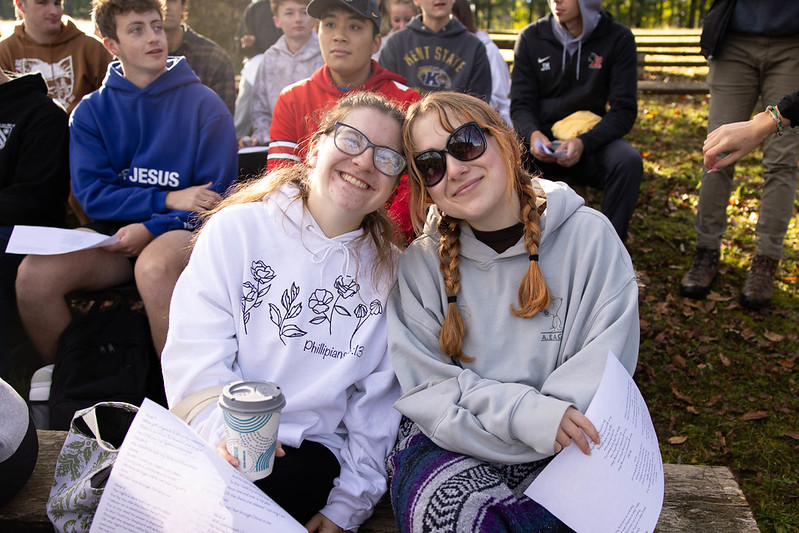
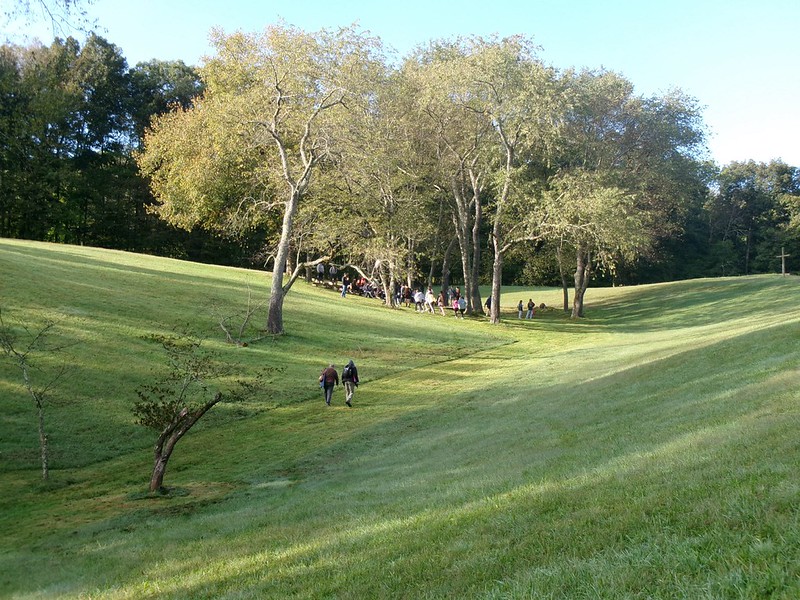
I always love our Saturday morning session, which we typically hold outdoors and keep shorter than the evening sessions. The natural beauty of the Appalachian foothills enhances the sense of worship. And we use this space to set students up for some individual time seeking God through prayer and reading the Bible.
Some students are understandably intimidated by the idea of 75 minutes of quiet time, but I think we queue things up for them pretty well, and we regularly hear that this slot in the schedule is many people’s favorite part of the weekend.
After the time for individual practice of spiritual disciplines, we have time for Life Groups to reconvene and process the things that they’ve been thinking and feeling and hearing from God up to that point in the retreat. We talk together, we pray together, and then we get lunch together. It’s really not all that mystical, but it still feels kind of magical how God works through these times.
After lunch, we did our “H2Olympics,” which are super-silly and super-campy. But again, they are surprisingly effective at getting people to come out from under their shells and work together to have fun and compete for a meaningless trophy. One of the teams from the North Campus Life Group that I coach won the H2Olympics this year (note that I still care enough to mention this), but everybody won new relationships that paved the way for deeper community to be developed through the subsequent free time and evening meal.
After dinner, we got to celebrate seven people getting baptized, and then we finished with our last session before heading home. It was a pretty great weekend, even though it was also exhausting. I eagerly anticipate the release of the professional photographer’s images from our church’s Fall Retreat (and will probably share some of my favorites from that collection when they’re made available, as well). But in the meantime, I like reflecting and sharing some of my favorite photos from Fall Retreat.
I recently finished reading the nonfiction book, Fuzz: When Nature Breaks the Law, by Mary Roach. I got it from the library at the beginning of the summer and kept chipping away at it all summer long (whenever the electronic version of the book was available from the Kent Free Library). It wasn’t much of a page-turner, but that was just as well for a book that I would read at the end of the day, winding down in bed. And it was interesting enough that I kept coming back to it.
Mary Roach is writer with a unique niche: sort of journalist, sort of humorist. I feel like I’ve read some of her stuff before, but I can’t remember exactly where. But this book was not only interesting because of Roach’s casual style (which I judged to be well-suited to summertime reading), but also because of the subject material: the points of friction between human civilization and wildlife, which are becoming more intense because of climate change and the growth of the human population on Earth.
In spite of that last sentence, Roach doesn’t have much of an axe to grind politically. She just seems to be a curious person, who notices things and tries to understand the underlying dynamics.
There’s a chapter about bears in the Rocky Mountains… And other chapters about elephants and leopards and macaques in India… Cougars in California… Douglas firs in British Columbia… Crows in the American Midwest… Albatrosses in the South Pacific… Deer in Ohio… Vultures in Florida… Gulls and Rats in Vatican City… Stoats and brushtail possums in New Zealand… Mice in Colorado… It really is kind of fascinating to see how all these different populations of living organisms interact with each other.
I thought it was especially fascinating to read about the way that the U.S. military has thrown its considerable weight into waging a war against albatrosses (which are also sometimes called goonies) on Midway Island. The military’s planes were dealing with so many bird strikes that they tried dozens of different strategies to diminish or extinguish the local population of albatrosses. They tried rifles, pistols, bazookas, mortars, carbide exploders, fire… They tried kidnapping and moving the birds’ eggs… They clubbed tens of thousands of birds to death… They tried to interfere with the albatrosses’ nesting sites with wires… fabric… mothballs… live snakes… recordings of distress and alarm calls… even bulldozers reshaping the topography! And nothing could dislodge the birds.
This was my main takeaway from the book as a whole. We humans have a lot of power, but not absolute power. We may think we have it in us to destroy or save the planet, but that’s honestly just hubris. An airman from Midway is quoted as saying, “It’s my bet that no matter what we throw at them, when it’s all over, Midway will still be the Gooney territory and ourselves only transients subject to the whims of a bird that refuses to be conquered.”
I enjoyed my reading of Fuzz, and I can recommend it to those who enjoy learning weird facts about the natural world. This book is really a survivor from my Summer of Reading Frustrations. But it’s probably not going to make it into my Top Ten Books for 2026, for whatever that’s worth.
On the Thursday of the first week of classes, we experienced the culmination of ten days of intense outreach with an outdoor preview of our Worship Gatherings and Life Groups. And it went really well. Between you and me, though, it wasn’t as easy as we made it look.
It started with some trouble finding a place for our H2O Kickoff event on the Thursday of the first week of classes. To make the longer story short, our usual spot was unavailable — so we decided to reserve some outdoor space in the center part of campus. The Student Green is actually a lovely spot, right in the middle of campus, where foot traffic is consistently heavy at just about any hour of the day. But this location also depends on favorable weather. And at the beginning of the week, the forecast called for a 40 percent chance of rain that Thursday evening. By God’s grace, the chance of rain kept dropping with each day that we approached the Kickoff. So we felt pretty confident that the outdoor location was going to work, as we got within the last 24 hours before it happened…
But then there was a malfunction with the University’s sprinkler system. One campus employee told us that the sprinklers watering the grass are supposed to shut off at 7:30 AM. And maybe they did. But we have some reason to believe the sprinklers ran continuously until we came to set up around 3:30 PM. When maintenance was finally able to turn off the water around 4:00 PM, there were two inches of standing water on some parts of the Student Green. Just four hours before the official start time of our event. The middle part of the Student Green wasn’t too squishy or muddy, though, so we decided to press on with our plans for the H2O Kickoff.
The outdoor location certainly had its stresses, but on the plus side — it was easy for Kent State University students to find us. That’s really the goal of this event: helping students to know that there is a church on campus, a space for spiritual development among one’s peers. In addition to providing opportunities to see how we worship and how we teach from the Bible, we introduced our church’s Life Groups and sent out coolers of frozen treats to the four corners of campus where students could meet and mingle with other students (and staff and volunteers) from the different groups. There were about forty of us who walked from the Student Green to Crawford Hall in the North part of campus, and it really was lovely to get some space to interact with new people.
The outdoor location certainly had its stresses, but on the plus side — it was easy for Kent State University students to find us. That’s really the goal of this event: helping students to know that there is a church on campus, a space for spiritual development among one’s peers. In addition to providing opportunities to see how we worship and how we teach from the Bible, we introduced our church’s Life Groups and sent out coolers of frozen treats to the four corners of campus where students could meet and mingle with other students (and staff and volunteers) from the different groups. There were about forty of us who walked from the Student Green to Crawford Hall in the North part of campus, and it really was lovely to get some space to interact with new people.
For most of the walk across campus, I talked with a young woman from Cincinnati named Havana — and I got to learn how she has started following Jesus over the last couple of years. I enjoyed some brief interactions with Foster and James, and I got connected on LinkedIn with a young first-year student named Ryan. I ate a chocolate-covered ice cream bar while talking with Madison and Grace, and then I ate a frozen fruit bar while talking with two women named Kierstin, whose first, middle, and last names were remarkably similar even though they had just met each other that night. Marci and I got to talk together with Najmul and Miri, who are from Bangladesh. And I also got to develop some good rapport with Patricia and Milka, from Rwanda, when I applied a lesson that some other Rwandan students had just taught me about the pronunciation of their country’s name (two syllables, not three). It ended up being a pretty great night, honestly. There are so manystories that God is writing here in Kent (the little details from this paragraph are just the tip of the iceberg!)… God knows how they will all turn out. But we have to keep walking by faith to find out for ourselves.
Thanks to all of you who have been praying with us and for us! And thanks for being a part of the ministry team that provides the financial support for this work, too. I’m getting back to the work of ministry team development, now that things are up and running on campus. We’ve still got $950/month left to raise — which is way better than where we were at this point last year, but still not quite where we want to be. Please pray for God’s provision in this, too. We’ll be in touch…